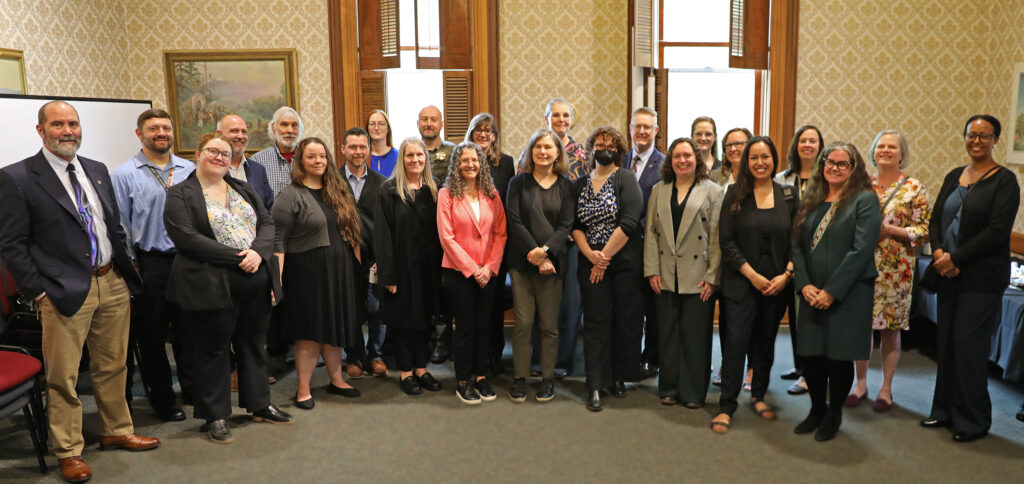
The Benton County Board of Commissioners proclaimed March 2026 as Women’s History Month during its March 3 meeting. The proclamation followed a gathering that included female leaders from across County government.
Women’s History Month began as a local celebration in Santa Rosa, California, in 1978. In 1987, Congress designated March to honor women’s contributions to history, culture and society. March aligns with International Women’s Day on March 8, observed worldwide since the early 1900s to recognize women’s rights and achievements.
Lacey Mollel, director of Linn-Benton Community Health Centers, read the proclamation into the record.
Mollel said the proclamation recognizes the role women have played in shaping communities and advancing progress in education, science, the arts, government and business. The 2026 national theme, “Leading the Change: Women Shaping a Sustainable Future,” highlights women’s leadership in addressing environmental, economic, educational and societal challenges.
“Women’s History Month is a time to honor the remarkable achievements of women past and present who have overcome obstacles, broken barriers and paved the way for future generations,” Mollel said during the reading. “It provides an opportunity to recognize the many contributions women have made to the social, economic, cultural and political fabric of our community and our nation.”
Lacey Mollel, executive director of Community Health Center of Benton and Linn Counties, reads the Women’s History Month proclamation before the Board of Commissioners on March 3.
And for Commissioner Nancy Wyse, Women’s History Month touches deeply on her own role in the County as well as the roles of other women in public service.
“Women working in Benton County government play important roles, including in leadership,” Wyse said. “Women leaders often take a holistic view, considering family systems, community factors and the long-term well-being of their teams and community partners. We have made progress, and Women’s History Month provides time to reflect.”
Maura Kwiatkowski, administrative services manager for the Board of Commissioners who coordinated the gathering and proclamation reading, said recognition creates space for important conversations.
“Many women hold family responsibilities while serving in demanding roles,” Kwiatkowski said. “In some environments, women still encounter bias or the need to continually prove credibility. Gender equality is an ongoing conversation. Visibility during Women’s History Month invites those conversations to happen.”
In adopting the Proclamation, the Board encouraged community members to celebrate and support the women of Benton County and to foster opportunities for education, empowerment and collaboration.
Header image: Commissioner Nancy Wyse (third from left) stands with some of the women leaders honored this week (from left): County Engineer Laurel Byer, Administrative Services Manager Maura Kwiatkowski, Executive Director Lacey Mollel of the Community Health Center of Benton and Linn Counties, Health Services Business Operations Director Debbie Sessions, Health Department Director April Holland.
The Benton County Board of Commissioners voted on March 3 to deny the proposed expansion of the Coffin Butte Landfill, reversing their previous decision. The decision on reconsideration has been transmitted to the Oregon Land Use Board of Appeals.
The Board adopted the findings in a Feb. 24 staff report as the findings of fact, removing the need for staff to prepare findings of fact for the Board to adopt in the March 17 Board meeting as originally planned.
Reversal of the previous decision
The previous Board of Commissioners’ public record for land use case LU-24-027 was closed in October 2025, preventing any new evidence from being entered. The Board voted on Nov. 4 to approve Republic Services’ Conditional Use Permit application to expand the landfill.
That decision was appealed on Dec. 5 to the Oregon Land Use Board of Appeals.
In a Board of Commissioners meeting on Dec. 16, Commissioner Nancy Wyse moved to withdraw the decision for reconsideration, per ORS 197.830(13)(b). Commissioner Pat Malone seconded the motion, which carried 3-0.
Because quasi-judicial land use cases must be discussed in public meetings with notification published in advance, the reason for Commissioner Wyse’s motion was not known until a public hearing on Jan. 20.
In that hearing, following a brief presentation by Planning staff, the Board reopened the LU-24-027 public record to accept a DEQ pre-enforcement notice published Nov. 6.
The record remained open for 7 days to accept written evidence, argument and public testimony related to the DEQ pre-enforcement notice. For the next seven days, anyone could submit responses to material submitted in the first seven-day period. Finally, the applicant had seven days to submit a final rebuttal before the record was closed.
On Feb. 24, County Planning staff released a report reviewing all evidence submitted during the 21 days the record was reopened. The report included a different recommendation than the previous staff report:
Staff finds that the November DEQ PEN calls into question some of the application’s odor model assumptions, as further explained below, and further that the application does not provide sufficient analysis of adjacent odor-sensitive land uses such as the neighboring horse therapy business and residences to demonstrate that the landfill expansion will not seriously interfere with those uses on adjacent properties. Therefore, the Applicant has not met its burden of proof to show that the proposed use will not seriously interfere with adjacent land uses. Staff recommends denial of LU-24-027.
The public hearing resumed on March 3. Commissioner Gabe Shepherd moved:
to adopt an order reversing the Board’s November 2025 decision, and that the Conditional Use Permit be denied based on evidence in the record and findings in the February 24, 2026 staff report, and conclusions developed by the BOC during these deliberations, and that these findings and conclusions be adopted as the final decision of the Board.
Commissioner Wyse seconded the motion, and the commissioners voted unanimously to adopt the order.
MONROE, Ore. — The Monroe Festival returns Saturday, May 16, 2026, and organizers are actively seeking vendors and sponsors to be part of this signature community event. Benton County and many other community partners plan to be there in support of the festival, celebrating the kind of local collaboration and community spirit that make Benton County a great place to live.
The fifth annual festival will take place from 10 a.m. to 6 p.m., with an expected attendance of 1,500 to 2,000 people. After a brief hiatus, the festival returns to its traditional late-spring timeframe, offering a prime opportunity for businesses, artisans and organizations to showcase their work to a large and engaged audience.
Local vendors, food trucks, wineries, breweries, distilleries, artisans and community organizations are encouraged to apply early to secure space. Sponsorship opportunities are also available for businesses looking to increase visibility and support a well-loved regional event.
Vendor applications and sponsorship forms can also be requested by emailing info@businessassociationofmonroe.org or can be picked up in person at Monroe City Hall.
Since its launch in 2019 as “Monroe’s Vino, Vintage & Victory (V3) Festival,” the event has drawn strong community support. After pausing during the COVID-19 pandemic, the festival returned with growing participation and expanded activities, including artisan vendors, food trucks, wine and beer tasting, a fishing derby, pie-eating contest, line dancing, axe throwing, historic trolley tours, a model railroad display and more.
Mayor Dan Sheets, one of the original organizers, said the festival continues to be a point of pride for the city.
“The Monroe Festival brings together neighbors, artists, crafters, businesses and families to celebrate what makes Monroe unique,” Sheets said. “It’s a great opportunity for local vendors and sponsors to connect directly with the community.”
The Business Association of Monroe is sponsoring the 2026 event and will share updates through social media and the official festival website.
For vendor applications, sponsorship information or event details, visit the festival website or contact Monroe City Hall at 541-847-5175.
Organizers say the Monroe Festival is more than a celebration, it is a chance for businesses and organizations to grow their reach while helping strengthen community pride and local economic vitality.
Visitors to Benton County’s Kalapuya Building at 4500 SW Research Way might notice new art on the walls the next time they stop by. The artwork is part of the Corvallis Art Guild’s Hanging Around Town program, which brings rotating exhibits by local artists into community spaces across Corvallis.
Artists are featured at the Kalapuya Building for about two months at a time, giving visitors an opportunity to experience different styles and perspectives throughout the year. Paintings are placed in lobbies and corridors on both levels of the building.
The current featured artist is Rhoda Fleischman, a longtime member of the Corvallis Art Guild whose work explores transformation and personal growth. Seven of her paintings are on display.
Ladders are a central motif in Fleischman’s paintings. She uses them to represent movement from one place or level to another.
“The ladder represents transformation,” Fleischman said. “It’s about moving from one state to another, whether that’s an internal journey or something happening in the world around us.”
Born in Portland, Fleischman now lives south of Brownsville and has been a member of the Corvallis Art Guild for more than 20 years. She began her artistic journey working in pottery before turning to painting in the early 2000s.
“I started painting around 2001 after a friend encouraged me to try it,” Fleischman said. “Once I began, I just kept going.”
Since then, painting has become a consistent part of her creative life, allowing her to explore ideas of change, growth and connection. Fleischman said the Corvallis Art Guild has played an important role in that journey.
“It’s a great organization with a long history,” she said. “There are workshops, opportunities to learn and a lot of supportive people who enjoy sharing ideas about art.”
Fleischman said she values the sense of community the organization provides.
“The Guild is very welcoming,” she said. “It’s a place where people can share their work and talk about art together.”
The Hanging Around Town program helps connect artists with the community by displaying artwork in everyday spaces such as public buildings, businesses and community centers.
At the Kalapuya Building, visitors can view Fleischman’s work during regular business hours while accessing county services or attending meetings. People are also welcome to stop by just to look at the art.
“It’s wonderful when people encounter art in unexpected places,” Fleischman said. “You never know what might resonate with someone.”
Additional artists will rotate through the Kalapuya Building exhibit approximately every two months. Artists interested in participating must be exhibiting members of the Corvallis Art Guild. More information is available at corvallisartguild.net.
As Benton County prepares to recognize the Day of Remembrance for Japanese Americans incarcerated during World War II, Benton County Deputy District Attorney Kevin Hashizume says the annual observance carries deep personal meaning rooted in his family’s history.
The national Day of Remembrance commemorates the signing of Executive Order 9066 in 1942, which led to the forced removal and incarceration of more than 120,000 Japanese Americans. Communities across the United States hold events each February to honor those affected and reflect on civil rights and civil liberties.
At the Feb. 17 Benton County Board of Commissioners meeting, Dr. Janet Seiko Nishihara, director of the Educational Opportunities Program at Oregon State University, will read a proclamation recognizing February 19 as the Day of Remembrance of Japanese Americans Incarcerated During WWII.
One year ago, Dr. Nishihara read a proclamation before the Board of Commissioners and reflected on both injustice and resilience. She said sharing personal and family histories remains critical to ensuring the broader community understands the lasting impacts of incarceration and why the message of “Never Again” must continue.
“Our stories are two of the thousands from the incarceration and can add greatly to the understanding of the larger community about the ramifications of what happened and why ‘Never Again’ is a theme that we must keep going,” Nishihara said.
She also emphasized that remembrance includes recognizing both the hardships faced and the strength communities demonstrated under confinement.
“Despite the conditions in which they lived, Japanese Americans were resourceful and stood up systems and structures that continued to bring their community together,” Nishihara said during the Feb. 2025 reading. “During this time, they created their own churches, post offices, security departments, fire brigades, schools, and recreational and educational activities for the many children in the camps. While all of these activities and internal structures were built by the incarcerated Japanese residents, they were still surrounded by armed guards and barbed wire, which were constant reminders of the denial of their civil rights.”
For Hashizume, this history hits close to home. His father, Naotaka “John” Hashizume, was a young child when his family was incarcerated at the Heart Mountain camp in Wyoming. Growing up, Kevin Hashizume said the experience was rarely discussed directly at home.
“We just called it ‘camp,’” Hashizume said. “As kids we thought it was like a summer camp or something.”
He said it was not until adulthood that he fully understood the emotional weight the experience carried for his father. Looking back, he began to notice patterns — including his father’s reluctance to travel outside California.
“He wanted to stay where he felt safe and comfortable, and he wouldn’t always say why,” Hashizume said. “It wasn’t until I was older that I realized how much it affected him.”
Hashizume said his own visit to Heart Mountain brought a new level of understanding. Seeing the location in person while his
Benton County Deputy District Attorney Kevin Hashizume stands beside family photographs, artwork and historical items related to Japanese American incarceration displayed in his office at the Benton County Courthouse in Corvallis.
children were close to the same age his father had been at the time created a powerful emotional connection.
“I thought about what that must have been like and whether I would have been strong enough,” he said. “They had a comfortable life in Hollywood with a nice house. Everything was taken, and they left with only what they could carry.”
Watching preserved home movies and photographs of his family playing as children while at Heart Mountain added another layer of emotion. Hashizume said he is proud his grandfather intentionally documented and safeguarded that history.
“It’s something we were never taught in school,” he said. “To know my grandfather put real effort into preserving it means a lot to be able to bring that history back into focus.”
The Hashizume family maintains strong ties to the Japanese American National Museum and to the Heart Mountain Interpretive Center in Wyoming, where interviews, photographs and artifacts connected to the family are archived and shared with the public.
Hashizume also noted that some modern migrant detention facilities exist near or on the same sites as former incarceration camps, one reason many families and advocacy groups continue to speak out and work to keep the history visible.
Benton County District Attorney Ryan Joslin said Hashizume’s family connection makes him a valuable resource when discussing the topic. Joslin noted that Hashizume keeps several historic photographs and related items displayed in his office and willingly shares them to help others better understand the history.
While D.A. Joslin does not have a personal family connection to wartime incarceration, the subject is meaningful to him. He lived in Japan from 1987 to 1989 and later majored in Japanese as an undergraduate, experiences he said gave him a lasting appreciation for the people of Japan, their culture and history.
An interview with Naotaka “John” Hashizume, conducted by the Japanese American National Museum when they brought part of the Eaton Collection to the Oregon Nikkei Legacy Center in 2016, is available on Japanese American National Museum YouTube.
Amateur footage from the Hashizume family collection, including scenes from Heart Mountain, is available through Discover Nikkei.
Women making paper flowers at the Heart Mountain incarceration camp in Wyoming, February 1945. Footage by Naokichi Hashizume, Naokichi Hashizume Collection (92.18.9), Japanese American National Museum, via Discover Nikkei.
Proclamations read before and adopted by the Benton County Board of Commissioners are a tool to formally acknowledge history and promote public understanding. The Hashizume family’s history serves as an important local example of the relevance of continuing to honor and learn from the past.
A drone view of Crystal Lake Cemetery in Corvallis shows one of Benton County’s historic pioneer cemeteries, where generations of local residents — including some of the region’s earliest Black pioneers — are laid to rest.
The Benton County Board of Commissioners proclaimed February 2026 as Black History Month during its Feb. 3 meeting, recognizing the achievements, history and cultural contributions of Black Americans both locally and nationwide.
John Phillips IV, president of the Linn-Benton NAACP, read the proclamation and spoke about the importance of honoring Black history while encouraging continued learning and open dialogue in the community.
John Phillips IV, president of the Linn-Benton NAACP, pauses for a photo after reading the Black History Month proclamation at the Benton County Board of Commissioners Office on Feb. 3, 2026, in Corvallis.
“It serves as a time to honor cultural heritage and promote awareness, education and inclusion,” Phillips said.
The proclamation notes that Black History Month began in 1926, through the work of historian Dr. Carter G. Woodson, and expanded to a month-long national observance in 1976. The 2026 national theme, “A Century of Black History Commemorations,” marks 100 years since the first formal celebrations of Black history in the United States.
But Black history in Benton County goes back a lot farther than that. The stories of Black pioneers remain visible in local names and community records. Crystal Lake Cemetery in Corvallis, managed by Benton County, is the final resting place of some of these local trailblazers.
Hannah and Eliza Gorman were among the first recorded Black residents of Corvallis, arriving in the 1840s as enslaved people and later purchasing property in the 1850s despite Oregon’s exclusion laws. Eliza became known locally for her seamstress skills, and her obituary in the Corvallis Gazette reflected the respect she earned within the community.
Louis, sometimes spelled Lewis, Southworth was born into slavery in Tennessee, bought his freedom and became a respected farmer, blacksmith and fiddler. He later lived in the Corvallis area. Southworth Creek bears his name as a lasting reminder of his presence and community impact.
Reuben and Mary Jane Shipley were early Black settlers who secured their freedom, became landowners and later donated the land that became Mt. Union Cemetery in Philomath. A historical marker today honors their family’s legacy and community contributions. Together, these local histories underscore the perseverance, resilience and community impact of Black Oregonians. As Benton County observes Black History Month, these stories help connect the past to the present, reminding residents that Black history is not only national in scope, but deeply woven into the foundation of our local community.
Mary Jane Holmes Shipley Drake (1841–1925), early Oregon resident and matriarch of one of Benton County’s Black pioneer families. Born into slavery, she gained her freedom and, with her husband Reuben Shipley, became a respected community member whose family helped shape local history. Courtesy of Wikimedia Commons (public domain).
The Hannah and Eliza Gorman House in Corvallis, associated with two of the earliest documented Black residents of Benton County. Hannah and her daughter Eliza arrived in the 1840s as enslaved people and later became property owners, with Eliza known locally for her seamstress work and community standing. Courtesy of Wikimedia Commons (public domain). Louis Southworth (c. 1800s), formerly enslaved, self-emancipated Black pioneer, farmer, blacksmith and fiddler in the Corvallis area. His legacy lives on in local place names such as Southworth Creek. Courtesy of Wikimedia Commons (public domain).
For Benton County Safety Officer Ray Woothtakewahbitty, service has always been about mission, people and accountability.
Woothtakewahbitty, whose name is Comanche meaning “arrive and strike,” comes from a family and culture with deep military roots. He is Comanche on his father’s side, and like many Indigenous peoples, the Comanche people have a long history of military service.
“Almost everyone on that side of my family served,” he said. “They were great role models. I knew from a young age that I wanted to serve.”
That commitment shaped a 25-year military career that included three combat deployments and a wide range of roles from shop mechanic and scout to maintenance leadership and first sergeant.
Woothtakewahbitty on deployment in Afghanistan in 2010. He completed three deployments during his 25-year military career, experiences he says helped build the calm, disciplined approach he now brings to his work with Benton County. (Courtesy photo)
A first sergeant is a senior enlisted leader who takes care of Soldiers and keeps the unit ready by enforcing standards, mentoring leaders and ensuring the mission gets done.
Along the way, Woothtakewahbitty led people and managed equipment and budgets, often in high-pressure environments where mistakes carried serious consequences.
“Almost every job I had in the military was stressful,” he shared. “I had jobs that were brutal working from 8 a.m. to 7 p.m. every day under pressure to meet quotas on recruiting duty, and days in the motor pool or on supply convoys in Afghanistan that only ended when the mission was complete. Being responsible for the lives and safety of my Soldiers in a combat zone was always stressful.”
Those experiences built a strong work ethic and a calm, steady approach that he brings to his work today with Benton County.
“I don’t get stressed out easily,” he said. “Being shot at and taking care of Soldiers while their lives are on the line gives you perspective. It helps me perform well in difficult situations.”
As Benton County’s safety officer, Woothtakewahbitty works largely behind the scenes, ensuring employees and the public are protected and that safety programs are effective and fiscally responsible. He said the military made safety second nature.
“In the Army, we did a risk assessment for every task or hazard and developed a plan to mitigate it. That mindset never leaves you.”
His military background also sharpened his ability to troubleshoot problems, stay calm under pressure and work with people from all walks of life. Over his career, he worked alongside West Point graduates, young Soldiers just out of high school, and people from many cultures and backgrounds.
“The military taught me how to relate to different people and embrace diversity,” he said. “I’m grateful for that exposure, and I appreciate that Benton County values diversity, too.”
Since joining Benton County, Woothtakewahbitty has partnered with department leaders to apply his military experience to real-world safety challenges, particularly for employees working along roadways.
“I’ve worked closely with Ray as he’s transitioned into this role, especially around improving safety for our road crews,” said BJ Haley, Benton County roads operations manager. “His military background shows in how he approaches risk, accountability and teamwork. He’s focused on making sure our crews go home safe at the end of the day, and that mindset strengthens our entire operation.”
Woothtakewahbitty said the sense of purpose he found in uniform continues in his civilian role.
“I care about service and mission,” he said. “I care about the people I work with and making sure they go home safe. That’s where I get my purpose. From serving others and being part of a team that’s doing something meaningful.”
For Woothtakewahbitty, the mission has changed, but the values remain the same. His commitment to service, teamwork and accountability closely reflects Benton County’s core value, “At Your Service, Every Day”, and guides how he supports coworkers and keeps people safe across the organization.
The 25th annual Festivus disc golf tournament returned to Adair County Park on Saturday, drawing players from across the region to celebrate both a winter tradition and 25 years of disc golf at the disc golf course in Benton County’s Adair County Park.
Tournament organizer “Disc Golf Greg” Johnson sounds an air horn to kick off the 2026 Festivus Disc Golf Tournament at Adair County Park.
The tournament’s name comes from the fictional holiday “Festivus,” popularized by the television show Seinfeld. Organizer Greg Johnson, known locally as “Disc Golf Greg,” said the lighthearted reference fits the tone of the event, which blends friendly competition with humor and community spirit during the winter season. The name also reflects the creativity and playful personality common in the disc golf community, where themed tournaments, inside jokes and casual camaraderie are part of the culture.
Johnson and a team of volunteers placed sponsor signs and directional markers on every hole to guide players through the wooded and open fairways. In the weeks leading up to the event, younger members of the local disc golf club refreshed pathways and tee areas using gravel and bark chips provided by Benton County.
While this year brought a different winner than the past decade, largely dominated by professional player Scott Withers, it was not a first-time champion. Colin Sexton captured the title with a two-round score of 22-under par across 44 holes, shooting rounds of 9-under and 13-under. Sexton, who turns 40 this year, previously won Festivus in 2010 and became the third repeat champion in the event’s history.
Professional disc golfer Nate Sexton, a six-time Festivus winner recognized for his national and international influence on the sport, finished one stroke behind his brother — who is one year younger — after a dramatic closing stretch. According to Johnson, Nate Sexton was down three strokes with three holes to play. On the final hole, which is the only par-4 on the course, his drive landed out of bounds near the tennis court fence, forcing an awkward recovery shot. From roughly 250 feet, Sexton skipped in a long throw to save par and put pressure on Colin Sexton, who converted his birdie putt to secure the one-stroke victory.
Players like Scott Withers and the Sexton brothers reflect the depth of talent in the local disc golf community, which continues to produce strong competitors across multiple divisions. This year also marked the first time the lowest overall score came from a player in the Pro Masters 40-plus division.
Jude Sweeney, 13, poses with his prize money after winning the Men’s Pro Open division at the 2026 Festivus Disc Golf Tournament (left) and drives a tee shot during tournament play at Adair County Park (right).
In the Men’s Pro Open division, 13-year-old Jude Sweeny delivered a standout performance, shooting 10-under for the tournament to earn his first MPO win. Sweeney, who continues to compete at the amateur level in sanctioned events, plans to travel to Pittsburgh in July to compete in the PDGA Junior World Championships. His father, Andrew Sweeny, said the victory “stoked his already strong passion for the sport and growing the game.” Jude hopes to build on a fourth-place finish at Junior Worlds in 2023.
Event sponsors including 2 Towns Ciderhouse, Play It Again Sports, Innova Disc Golf and Honeybrine Catering helped make this year’s Festivus the largest payout in tournament history. Cash payouts to professional players exceeded $2,000, while amateur competitors shared nearly $1,500 in store credit redeemable at Play It Again Sports in Corvallis.
Kim Halsey, who has played disc golf for about 24 years, said the sport offers a reliable way to step away from work and reconnect with friends.
“It’s just a really fun way to break out of my work rhythm and have a great time with friends,” Halsey said. “Every time I come out with my friends, I have a great time. You’re outside, you come out and play in the winter — there’s a little activation energy to come out, but as soon as you’re out you’re like, ‘I’m so glad I got here.’”
Halsey said the community is what keeps her returning.
“You never know what people are doing or what their history is, but they’re all super kind,” she said.
Participants in the 2026 Festivus Disc Golf Tournament gather for a group photo before the start of play at Adair County Park.
Dan Rockwell, recently elected president of the Willamette Disc Golf Club and a member for about six years, said the anniversary highlights both the course’s design and the partnerships that sustain it. He previously served as greenskeeper at the Willamette Park disc golf course before moving into club leadership.
“It’s a completely fun, community-building tournament that is for everyone to come and have a good time,” Rockwell said.
He described the Adair County Park course as offering a wide variety of shots, including wooded lanes, elevation changes, open fields and short technical holes, along with a strong sense of history tied to the volunteers who built and maintain it.
Benton County Natural Areas, Parks and Events Director Jesse Ott said the County works closely with the club to balance recreation with stewardship of the park.
“I love that we are highlighting disc in Benton County,” Ott said. “NAPE supports tournaments and clinics by working with the club on basket layout. We review the plans for the course and the event through our Special Use Permit.”
Ott said Adair County Park remains open to the public during events, but the permit process helps reserve the course and protect sensitive areas. County staff coordinate with volunteers and tournament directors to address pathway issues and to select basket sites that minimize impacts to emerging native plants during certain times of the year.
As discs sailed through air and across familiar fairways, Festivus once again reflected the local disc golf community’s blend of competition, volunteerism, humor and shared time outdoors. It’s a formula that has kept players returning to Adair County Park for a quarter century, continues to develop the next generation of players, and for many, is simply good for the soul.
A player throws a shot at the disc catcher during the 2026 Festivus Disc Golf Tournament at Adair County Park in Corvallis.Professional disc golfer Nate Sexton throws a forehand during the 2026 Festivus Disc Golf Tournament at Adair County Park in Corvallis.
Benton County has made a strategic decision to adjust the timeline for the planned Voluntary Periodic Review of the 2007 Comprehensive Plan. Work initially slated to begin this month will be postponed while the County conducts economic analysis and hires and trains key staff.
A comprehensive plan is a long-term policy document that guides growth, land use and development. It outlines goals while providing the legal foundation for zoning and development decisions.
Voluntary Periodic Review is used in Oregon law to describe the periodic evaluation and revision of a local comprehensive plan. According to the Oregon Department of Land Conservation and Development (DLCD), VPR ensures that comprehensive plans respond to changes in local, regional and state conditions, coordinate with other comprehensive plans and comply with statewide planning goals, statutes and rules.
While counties are not required to update their comprehensive plans on a set schedule, Benton County has chosen to engage in this effort in response to growth and changing community needs.
The Benton County Comprehensive Plan was last updated in 2007. Significant demographic, economic, environmental, legislative and sociopolitical changes in the last two decades have created a strong need to modernize it. The County’s goals for this effort include:
Aligning land use policies with community priorities
Ensuring compliance with Oregon’s statewide planning goals
Integrating resilience, equity and sustainability principles across all policy areas
Once the comprehensive plan is updated, the County will amend the Development Code to implement these policy changes.
In 2024, the County began preparations for the VPR process with the intention of publishing a revised plan around 2028.
Phase 1 was completed in 2024 and 2025. Funded through a DLCD Technical Assistance grant, this robust pre-planning phase included:
Identification of VPR tasks and discretionary planning items
Phase 2 of the project was expected to begin in January 2026 with a state-supported funding package, as indicated in the 2025-27 budget adopted by the Benton County Board of Commissioners.
As the County began planning and implementation for this phase, it became evident that three unforeseen factors had created challenges for the project timeline:
The County has been unsuccessful in hiring a new Community Development Director — a key leadership position for this project. A new recruitment was just launched for the position.
Reductions in federal and state funding that began in January 2025 have resulted in fewer financial resources than expected for the project. The County forecasted $350,000 from the state to support Phase 2 of the project, but in December 2025, was notified it would receive $50,000.
The Conditional Use Permit (CUP) application to expand the Coffin Butte Landfill has required shifting staff resources away from the comprehensive planning project to meet the unanticipated workload and extension of time.
In response to these challenges, the County has developed a revised plan to delay the start of Phase 2 by one year. The $50,000 in state funding will be used as identified in the grant application to complete one discrete and foundational task prior to the rest of Phase 2.
The County will conduct a Fiscal and Economic Opportunities and Impacts Analysis with an emphasis on enabling and supporting a resilient rural economy. This analysis will provide an essential baseline for the comprehensive plan update and may directly inform development of a new Capital Improvements Plan to be integrated with the County’s biennial budgeting process.
This one-year delay will enable County staff to complete a major project task while finishing work related to the CUP application for the Coffin Butte Landfill and administering a process to recruit, hire and onboard a new Community Development Director.
Staff and the Board of Commissioners will also have time to reevaluate the current budget to determine how best to fund the project The goal is to fully kick off Phase 2 of the project in January 2027.
Voluntary Periodic Review of the County’s Comprehensive Plan continues to be one of the highest priorities of the Benton County Board of Commissioners. While a project delay is not ideal, the County believes it will support the best possible result considering current conditions.
The Benton County Board of Commissioners voted unanimously to reopen the record for LU-24-027 to accept new evidence related to the proposed expansion of the Coffin Butte Landfill. Written comment and testimony directed to a November 6 letter from the Oregon Department of Environmental Quality, as it relates to the applicable criteria in the Benton County Code, can be submitted by the public until 4 p.m. on Tuesday, Jan. 27.
In a Jan. 20 public hearing to reconsider their decision on the land use case, the Board considered a recommendation from Planning Division staff to open the record to receive a DEQ letter issued after the Board voted in Nov. 2025 to approve the landfill expansion application.
Planning staff recommended a schedule for written public testimony, applicant final argument and a continuation of the hearing to March 3 for deliberations and decision. The Board approved the following timeline:
Tuesday, Jan. 20
LU-24-027 Public Record reopened to accept the Nov. 6 DEQ letter. It will remain open for 7 days to accept written evidence, argument and testimony related to the DEQ letter as it relates to applicable criteria in the Benton County Code.
Tuesday, Jan. 27, 4 p.m.
Deadline for the County to receive written evidence, argument and testimony relating to the DEQ letter.
Beginning of new, 7-day period limited only to responses to written evidence, argument and testimony submitted during the Jan. 20-27 submission period.
Tuesday, Feb. 3, 4 p.m.
Receipt deadline for 7-day responsive open record period.
Tuesday, Feb. 10, 4 p.m.
Deadline for the County to receive the applicant’s final argument, with no new evidence.
Tuesday, Feb. 24
TENTATIVE — Staff report (if any) on new evidence published.
Tuesday, March 3, 11 a.m.
Continued reconsideration hearing and Board deliberations in the Holmes & Shipley meeting room at 4500 SW Research Way in Corvallis.
Tuesday, March 17, 9 a.m.
TENTATIVE — Adoption of findings in regular Board of Commissioners meeting and transmittal of decision on reconsideration to the Oregon Land Use Board of Appeals. If adoption is scheduled for an earlier date, it will be announced on March 3.
Submitting written testimony
On Tuesday, Jan. 20, the Board of Commissioners reopened the public record for seven (7) days to collect written evidence and testimony from all parties, including the public, directed to the November 6 DEQ letter. Submissions must be received by 4 p.m. on Tuesday, Jan. 27.
Following the 7-day open record period, the record will remain open for a 7-day responsive comment period limited to written submissions from all parties addressing only new issues raised during the Jan. 20-27 submission period. Submissions must be received by 4 p.m. on Tuesday, Feb. 3.
There are four ways to submit written testimony:
Hand delivered to Board of Commissioners Office (suite 100) in the Kalapuya Building at 4500 SW Research Way in Corvallis.
Through thetestimony submission form on the County’s website. Please note that the form does not allow for attachments. To submit testimony with an attachment, use the email address above.
Mailed to Board of Commissioners Office, P.O. Box 3020, Corvallis, OR 97339. Mailed submissions must be received by 4 p.m. on Jan. 27 — the postmark will not be taken into consideration.